The Ontological Shock: A Comparative Analysis of Technological Disruption in Fine Arts and Music
The historical trajectory of creative production is defined by a recurring tension between human agency and mechanical automation. Whenever a new technology emerges to challenge the established modes of artistic creation, the resulting upheaval follows a remarkably consistent pattern. This pattern encompasses economic displacement, aesthetic gatekeeping, and a profound philosophical crisis regarding the nature of "soul" and "effort" in art. In the nineteenth century, this crisis was catalyzed by the invention of photography, which threatened the livelihood of portrait painters and prompted a fierce debate over whether a mechanical image could ever constitute fine art. In the early twentieth century, the conflict moved into the auditory realm with the advent of recorded sound and "canned music," which musicians’ unions decried as a soulless threat to "living" performance. Today, the creative community faces a similar inflection point with the rise of generative artificial intelligence (AI) in music and visual arts.
This analysis examines these historical parallels to demonstrate that the contemporary backlash against AI-assisted music tools and generative visual systems is not a new phenomenon. Rather, it is a continuation of a structural argument that has existed since the first daguerreotype. At the heart of this conflict is the "argument of time": the belief that the value of an artistic work is intrinsically tied to the labor and duration required for its production. By analyzing the transition from manual painting to photography, and from live orchestration to recorded media, this analysis elucidates how the creative establishment consistently retreats into the "soul" argument to defend its economic and cultural monopoly against the perceived effortlessness of the machine.
The Mimetic Crisis: Photography and the Displacement of the Artist’s Hand
The introduction of photography in 1839 represents arguably the most significant disruption in the history of visual representation. For centuries, the fine arts had been governed by a rigid hierarchy of subject matter, with history painting at the apex and portraiture following closely behind. The primary social and economic function of the professional painter was to record likenesses and document reality—a function that required years of rigorous training in perspective, anatomy, and color theory.
The Economic Collapse of the Portrait Market
Before the photographic revolution, a portrait was a significant investment of both time and money. The elite commissioned oil paintings that required multiple, lengthy sittings, while the emerging middle class relied on miniatures or silhouettes to preserve family likenesses. The daguerreotype shattered this business model by offering an unprecedented level of detail and realism at a fraction of the cost. Photographic studios proliferated rapidly in urban centers, and the public’s desire for affordable likenesses created an immediate economic crisis for traditional painters.
| Feature | Traditional Portrait Painting (Pre-1839) | Early Photographic Portraiture (1840s-1860s) |
|---|---|---|
| Primary Labor | Manual application of pigment/ink | Chemical and mechanical fixation of light |
| Time to Create | Hours to weeks (multiple sittings) | Minutes (single exposure, though long) |
| Economic Barrier | High; reserved for the wealthy | Low to Moderate; accessible to the middle class |
| Fidelity/Detail | Subjective; idealized by the artist | Objective; "warts and all" realism |
| Market Stability | Secure monopoly for centuries | Rapidly disrupted by industrial studios |
The reaction from the painting community was one of profound anxiety. French painter Paul Delaroche, upon viewing his first daguerreotype, famously declared, "From today, painting is dead". For many nineteenth-century painters, photography was synonymous with commercial disaster and declining commissions. The "neck-clamp" days of early photography, which required subjects to remain perfectly still for several minutes in bright light, resulted in rigid and expressionless images, yet the public still preferred these "mechanical" records over the more expensive and less detailed products of the painter’s hand.
The "Artist-Photographer" and the Hybrid Era
Despite the initial hostility, the relationship between painting and photography quickly became one of complex interdependence. Many professional artists recognized that they could not beat the technology and instead chose to co-opt it. By the 1860s, a new class of "artist-photographers" emerged. These individuals leveraged the prestige of photography while employing painters to colorize photographs or paint over enlarged images on photosensitized canvas. This hybrid process allowed for the production of life-sized, colored portraits that resembled oil paintings but were produced with the speed and accuracy of the camera.
This historical transition mirrors the current "AI-assisted" era in music and art. Just as nineteenth-century photographers hired professional artists to "inject more realism" and "color" into their mechanical outputs, modern creators use AI tools to generate foundational tracks or images, which they then refine and polish. The historical record suggests that the "displacement" of a business model does not necessarily mean its total destruction, but rather its transformation into a more integrated, technology-dependent practice.
The Baudelairean Critique: The Soul vs. The Industrial Image
The most enduring argument against photography—and the one that resonates most clearly with modern critiques of AI—is the claim that the machine is devoid of "soul" and "imagination." Charles Baudelaire, the preeminent voice of the French avant-garde, emerged in 1859 as the most vocal critic of the photographic industry. In his review of the Paris Salon, Baudelaire denounced photography as "art’s most mortal enemy".
The Definition of Artistic Realism
Baudelaire’s objection was not rooted in a dislike of the technology itself, but in its potential to corrupt the definition of art. He believed that true art was the reflection of a "mental world" consisting of "imagination, dreams, and fantasy". He argued that if photography were allowed to encroach upon the domain of the "impalpable and the imaginary," it would contaminate the human soul. For Baudelaire, the public's fascination with photographic "exactitude" was a manifestation of a "squalid society" that preferred to gaze at its "trivial image on a scrap of metal" rather than engage with the spiritual visions of a master painter.
This sentiment is echoed in modern discourse surrounding AI music. Critics of tools like Suno and Udio often refer to their outputs as "soulless" or "slop," arguing that because the "creator" only inputs a text prompt, the resulting music lacks "artistic intention" and "personality". The Baudelairean fear—that a mechanical process will cause the public to lose its faculty of judging and feeling the "ethereal and immaterial" aspects of art—is exactly what modern musicians express when they warn that AI will "devalue the rights of human artists" and "diminish our shared culture".
The Refuge of the Failed Artist
Baudelaire further hypothesized that the photographic industry was the "refuge of every would-be painter" who was too "ill-endowed" or "too lazy" to complete their studies. This characterization of the new technology user as "lazy" or "cheating" is a persistent theme in the history of disruption. In the mid-nineteenth century, artists using the camera obscura or camera lucida were often accused of bypassing the "noble" labor of free-hand drawing.
Today, this same critique is leveled at "prompt engineers" and AI enthusiasts. Professional musicians argue that "pretending that typing a text prompt into Suno makes one a musician inflates the worth of that output," essentially calling into question the authorship of anyone who shortcuts the years of practice required to master an instrument. The historical and modern arguments both treat "labor" as a moral prerequisite for "art."
The Argument of Time and the "Effort Heuristic"
A central pillar of the resistance to both photography and AI is the belief that the value of art is proportional to the time and effort expended by the creator. This concept, often referred to in modern psychology as the "effort heuristic," suggests that humans are hard-coded to value products more if they perceive that more labor went into them.
John Ruskin and the Virtue of Imperfection
The nineteenth-century critic John Ruskin famously argued that "effort is the point". Ruskin believed that the "machine-ground perfection" of industrial products was a sign of "slavery" because it denied the worker any autonomy or personal expression. For Ruskin, the "irregularities and deficiencies" in a hand-painted scene were not flaws, but "sources of beauty" and "signs of life". He warned that the demand for "perfection"—such as that offered by the camera—was a sign of a "misunderstanding of the ends of art".
Modern studies have confirmed Ruskin’s intuition. Research into perceptions of AI art shows that participants consistently rate artworks higher on scales of "Liking," "Beauty," and "Profundity" when they believe the work was "human-created". When a work is labeled "AI-created," its perceived value drops, even if the image itself is aesthetically identical to a human work. This "anti-AI bias" is directly linked to the perception of effort; participants rate the "Effort" and "Time to create" as significantly higher for human-labeled works, using these metrics as a proxy for artistic quality.
The Speed of Pictorial Reproduction
The transition from the hand to the lens accelerated the process of pictorial reproduction to a speed that could, for the first time, keep pace with human speech. This acceleration was seen by some as a democratic triumph. Oliver Wendell Holmes Sr. viewed photography as a "mirror with a memory" that would objectively record the "infinite amount of detail" that a human artist might intentionally omit. Holmes envisioned a "vast library of stereographs" that would democratize knowledge by separating "form" from "matter," allowing the masses to "visit" distant wonders through photographs.
However, the establishment viewed this speed as a threat to the "ennobling discipline" of the craft. Just as Baudelaire feared the "lazy" painter, modern musicians fear that AI's ability to "spit out human-sounding music in seconds" will lead to a "hollowing out" of self-expression. The complaint that "AI users barely do any of the work besides writing the prompt" is functionally identical to the nineteenth-century complaint that a photographer merely "presses a button".
Canned Music and the Mechanical Menace: The 1930s Uproar
The history of musical technology offers a striking parallel to the current AI debate through the lens of the "Canned Music" controversy of the late 1920s and early 1930s. This period saw the transition from live pit orchestras in movie theaters to synchronized recorded soundtracks—the "talkies".
The Music Defense League and the Robot Campaign
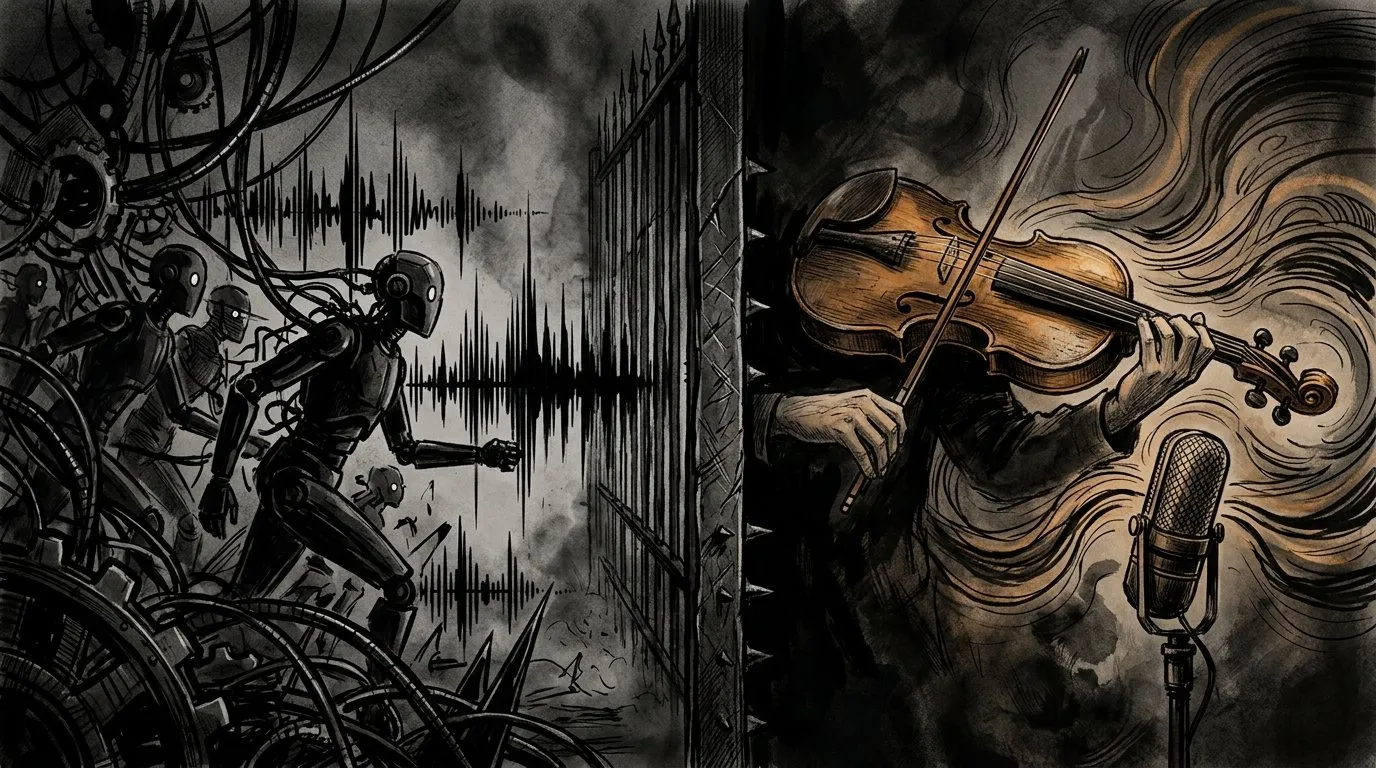
In 1930, the American Federation of Musicians (AFM) launched a $500,000 national advertising campaign through an organization called the Music Defense League. The goal was to convince the public that recorded sound was an "evil" and "mechanical" threat to the "soul of art". The campaign featured visceral imagery of "dastardly, maniacal robots" performing music, symbolizing the displacement of human musicians by cold, unseen machines.
| Argument in "Canned Music" Campaign (1930s) | Argument in Modern AI Music Debate (2020s) |
|---|---|
| "Robots have no soul." | "AI has no life experience; it hasn't earned the right to sing the blues." |
| "300 musicians in Hollywood supply all the 'music' for thousands of theaters." | "AI models train on billions of datasets to replace human songwriters." |
| "Recorded sound is a 'terrible menace' and 'scientific development at the expense of art.'" | "Generative AI is a 'disruptor' that devalues human artistry and creates 'slop'." |
| "The public will tire of mechanical music and want the real thing." | "AI will lead to 'model collapse' and a 'ceaseless remix of the past'." |
The AFM’s rhetoric focused on the loss of the "human feel" and the "expressivity of live players". Union President Joseph N. Weber cautioned that the time was coming when "the only living thing around a motion picture house will be the person who sells you your ticket". This "scare campaign" sought to frame recorded music not as progress, but as "artistic debasement".
The Devaluation of the Professional Musician
The economic impact of the "talkies" was devastating. Thousands of musicians who had made a living accompanying silent films were dismissed overnight as theaters switched to mechanical playback. This displacement led to a "panic" among musicians and a sense that their skills no longer had any market value.
This historical displacement provides a direct precedent for the modern musician's fear of AI. When managers and record labels see AI as a "convenient replacement" for "notoriously difficult musician personalities" (who don't demand renegotiated deals or go to rehab), the professional musician faces the same existential threat as the 1920s pit orchestra player. The AFM’s insistence that "music has charms to soothe the savage beast... but it has no power to appease the Robot of Canned Music" is the same sentiment expressed by today’s artists who argue that AI "can only succeed if developers are willing to work together with us" rather than exploiting their "life's work".
The Player Piano: The First Generative Instrument?
Before the AI synthesizer, there was the player piano. In the early twentieth century, the "Pianola" and other "reproducing pianos" brought high-quality music into the average American home. These machines used perforated paper rolls to operate the piano action automatically, often recording the exact dynamic expressions of world-class pianists like Rubinstein and Horowitz.
The Democratization of Performance
The player piano was marketed as a way to give "everybody the joys of creating music," even if they lacked the talent or time to learn the instrument. Some models allowed users to control the tempo, dynamics, and even transposition of the music, creating an "interactive playing experience" that predates modern generative interfaces.
However, the "Golden Era" of the piano industry was eventually killed by the emergence of radio and the phonograph—technologies that were even more "frictionless" and less expensive than a player piano. The transition from "active" listening (operating a Pianola) to "passive" listening (turning on a radio) mirrored the current concern that AI tools like Suno will make the act of "creation" too easy, thereby removing the "rush and joy" that comes from the struggle of the craft.
The Resistance to "Ready-Pirated" Music
John Philip Sousa, the famous bandleader, was a fierce critic of the phonograph and the player piano, warning that they would lead to a future where "no one will be ready to submit himself to the ennobling discipline of learning music". He feared that people would have "ready made or ready pirated music in their cupboards" and that the "amateur musician" would vanish.
Sousa’s term "canned music" was meant to imply that pre-recorded sound was "stripped of its freshness and soul". This is functionally identical to the modern complaint that AI music is "statistically average" or "slop" that "substantially dilutes the royalty pools paid out to artists". The historical cycle suggests that the establishment always views any reduction in the "discipline" required for creation as a degradation of the art form itself.
The Copyright Battle: From Oscar Wilde to AI-Generated Tracks
The debate over the authorship of machine-generated works has significant legal precedents that tie the nineteenth century directly to the twenty-first.
Burrow-Giles v. Sarony: The Proof of Intellect
In 1884, the Supreme Court case Burrow-Giles Lithographic Co. v. Sarony addressed whether photographs could qualify as "writings" of an "author" under the Constitution. The defense argued that a photograph was a "mere mechanical reproduction" of reality and could not embody an author's "idea".
The Court ruled in favor of the photographer, Napoleon Sarony, because he had demonstrated "original intellectual conceptions". Sarony had:
- Posed the subject (Oscar Wilde).
- Selected and arranged the costumes and draperies.
- Arranged the light and shade to present "graceful outlines".
This ruling established that a work produced by a machine (the camera) could be copyrighted, provided a human being exercised sufficient creative control over the "expressive elements" of the output.
The Modern Authorship Requirement
Today, the U.S. Copyright Office is applying a remarkably similar standard to AI-generated works. In the case of Zarya of the Dawn, the Office granted copyright to the book’s text and the "creative arrangement" of the images, but denied registration for the AI-generated images themselves. The reasoning was that the user did not have enough control over the "unpredictable" output of the Midjourney algorithm.
Similarly, the Copyright Office has denied registrations for works where the author is identified as an "AI algorithm" or "Creativity Machine," insisting that authorship requires a "human being". This legal stance is a direct descendant of the nineteenth-century view that "books only, or writing in the limited sense" were within the scope of copyright, until the Sarony case expanded the definition to include human-directed mechanical processes.
| Era | Technological Challenge | Legal/Social Resolution of Authorship |
|---|---|---|
| 19th Century | The Camera (Photography) | Authorship established by "posing and lighting" (Sarony, 1884). |
| 20th Century | The Phonograph/Radio | Royalties established for "mechanical reproduction" and "broadcast." |
| 21st Century | Generative AI (LLMs/Diffusion) | Current stance: AI cannot be an author; human input must be "significant." |
The "unpredictability" of AI is the modern version of the "mechanical nature" of the camera. Both are used as arguments to deny the status of "author" to the technology’s user until a sufficient layer of human "intent" and "arrangement" can be proven.
The Plagiarism Machine: Historical and Modern Perspectives
One of the most intense criticisms of generative AI is that it "steals" from artists by training on their work without consent. The RIAA has filed landmark lawsuits against Suno and Udio, alleging "massive unlicensed copying of sound recordings". Critics label AI as the "world's most efficient plagiarism machine".
The Mirror and the Pattern
This argument, too, has historical roots. Because the camera "directly captures reality," it was initially criticized as a form of "copying" rather than "creating". Critics in the nineteenth century argued that a photographer was merely "taking" a scene that already existed, whereas a painter was "making" something new using their unique vision.
The difference, according to modern skeptics, is that while a photographer captures a representation of a scene with intentional technique, AI recombines elements from a database to mimic what it has seen. However, AI proponents argue that the technology simply "learns patterns" and "borrows" ideas just as human artists imitate their masters during their training.
The Crisis of Authenticity
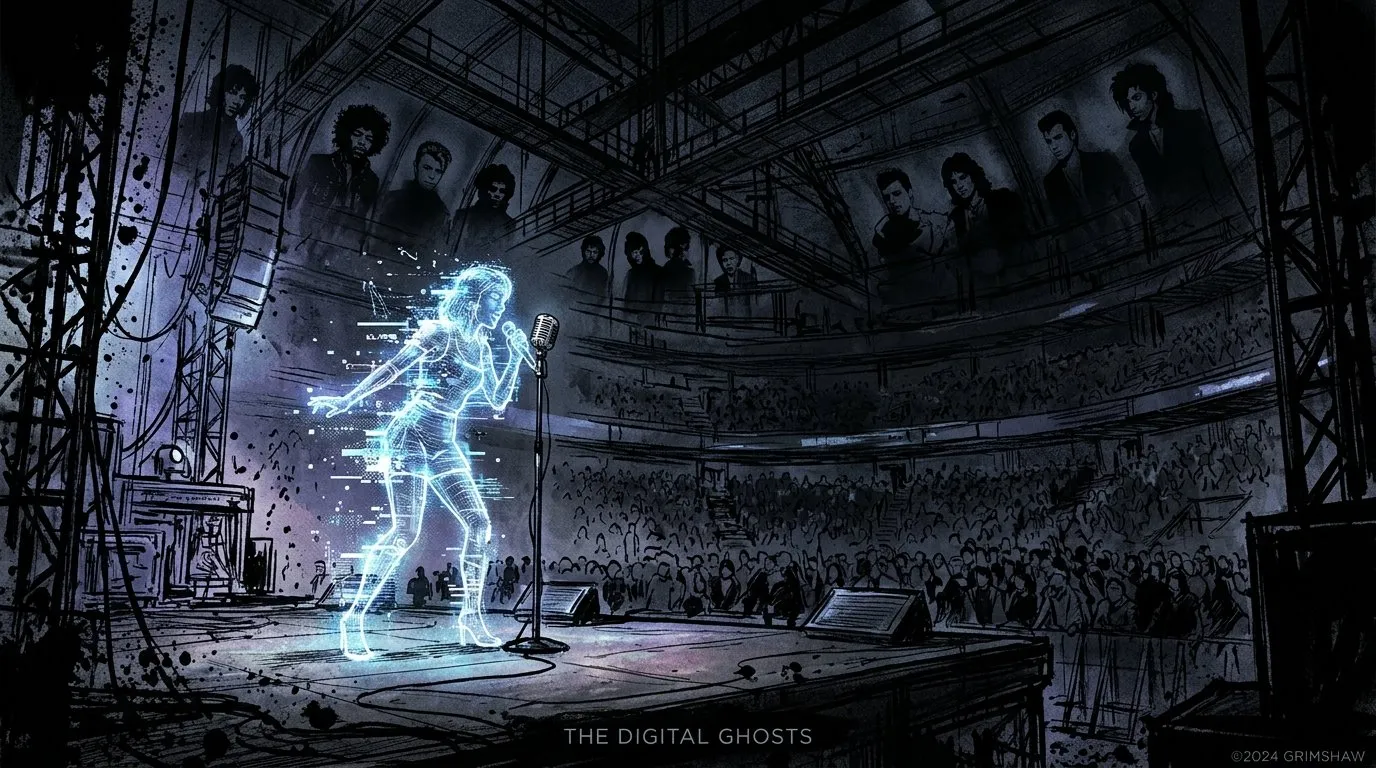
The rise of AI music "covers" on platforms like TikTok—where dead singers like Elvis are "made" to sing contemporary songs—has fueled a crisis of authenticity. Walter Benjamin’s concept of "reproduction" is central here; he argued that technology changes how art is perceived by separating it from its "basis in cult" and its "presence of the original".
As AI music becomes indistinguishable from human music to the average listener, the industry faces the threat of "devaluation" through an "inexhaustible supply of knock-offs". This is the modern version of the "300 musicians in Hollywood" complaint: the fear that a small amount of "training data" (or studio musicians) can replace a vast ecosystem of human creators.
The Resilience of Art: How Painting Survived Photography
If the historical pattern holds, the "uproar" against AI will eventually subside as the technology is integrated into the artistic process. The example of painting in the wake of photography offers the most optimistic outcome.
Artistic Liberation
Far from killing painting, photography "liberated" it. As the "accurate imitation of nature" became the domain of the camera, painters were forced to explore what the camera could not capture:
- Impressionism: Focusing on atmosphere, changing light, and subjective impressions.
- Expressionism: Exploring inner emotional states and non-representational forms.
- Abstract Art: Moving away from the "mirror up to nature" ideal entirely.
Art historian Aaron Scharf even stated that "without photography, there would have been no Impressionism". The technology acted as a catalyst for a revolution in "the way we see the world".
The Future of Music in the AI Era
In the music industry, AI may lead to a similar "analog revival" or a focus on "hyper-human" performance. We are already seeing research suggesting that while AI can "spit out human-sounding music," it still lacks the "creativity" and "novelty" of tunes made by people. Listeners still value the "relationship between the music, the artist, and the listener" that is forged through shared human experience—something AI "hasn't earned the right" to simulate.
Just as painting survived by becoming less like a photograph, music may survive AI by becoming more about the things a machine cannot do: live improvisation, physical performance (the "shaping of pitches"), and the expression of "brutal or aching" personal history.
Synthesis: The Persistence of the "Soul" Argument
The core themes of the historical record indicate that the establishment’s response to disruptive technology is never truly about the technology itself, but about the protection of the "human mark."
| Aspect of the Argument | 19th Century (Photography) | 20th Century (Canned Music) | 21st Century (Generative AI) |
|---|---|---|---|
| The Labor Objection | "Pressed a button" vs. "Stern labor" of the hand. | "Mechanical playback" vs. "Living performance." | "Prompt engineering" vs. "Creative struggle." |
| The "Soul" Objection | "Mechanical replica" vs. "Dreams and fantasy." | "Evil robots" vs. "Emotional art." | "Synthetic slop" vs. "Human experience." |
| The Quality Objection | "Warts and all" vs. "Idealized beauty." | "Inferior recording" vs. "Direct audio." | "Statistical average" vs. "Novel creativity." |
| The Economic Threat | Displacement of portraitists/illustrators. | Displacement of pit orchestras/piano makers. | Displacement of session musicians/songwriters. |
The "argument of time"—that art must take a long time to be valuable—is the common thread. Whether it was the "ten years" Ruskin gave to the study of art, the "seven years" to make a good pianist, or the decades a modern musician spends "practicing their craft," the arrival of a "seconds-long" alternative is always viewed as an "assault on human creativity".
The historical evidence suggests that we are currently in the "Music Defense League" phase of AI adoption—a period of intense hostility, legal challenges, and "soul-based" gatekeeping. However, just as the daguerreotype eventually became the "artist's tool" and the phonograph became the foundation of the modern music industry, AI tools are likely to be assimilated. The "real question" isn't whether AI art is valid, but how human creators will "level up" their practice by focusing on the "vision, intention, and expression" that remain the unchallenged domain of the sentient mind. In the end, the "soul" of art is not in the process, but in the human decision to make something that speaks to another human soul.